Aviator Multiplier Targets and Their Odds Explained
A $10 stake at 2x returns $20 before the stake is counted. A $10 stake at 10x returns $100. The target changes the possible payout, but it also changes how often the round reaches that target.
Aviator is a crash game by Spribe. Its multiplier rises from 1.00x until the round crashes, and the crash point is fixed before take-off. This article focuses on the 0.97/m formula, the probability table, and practical ways to match a target to a bankroll.
Aviator Multiplier Formula
Aviator has an RTP of 97% and a house edge of 3%. The probability that a round reaches multiplier m is calculated as 0.97/m.
Use the target multiplier as the value of m. For a 2x target, divide 0.97 by 2. The result is 0.485, or 48.5%. For a 10x target, divide 0.97 by 10. The result is 0.097, or 9.7%.
- At 1.2x, the calculation is 0.97 divided by 1.2, giving 80.8%.
- At 2x, the calculation is 0.97 divided by 2, giving 48.5%.
- At 5x, the calculation is 0.97 divided by 5, giving 19.4%.
- At 20x, the calculation is 0.97 divided by 20, giving 4.85%.
- At 100x, the calculation is 0.97 divided by 100, giving 0.97%.
The formula describes the chance that the round reaches a target. It does not predict the next round. Rounds are independent, so a recent run of low or high multipliers does not change the calculation.
About 3% of rounds crash instantly at 1.00x. That is roughly 1 round in 33. The 3% figure matches the house edge, but it does not mean every 33rd round will crash at 1.00x.
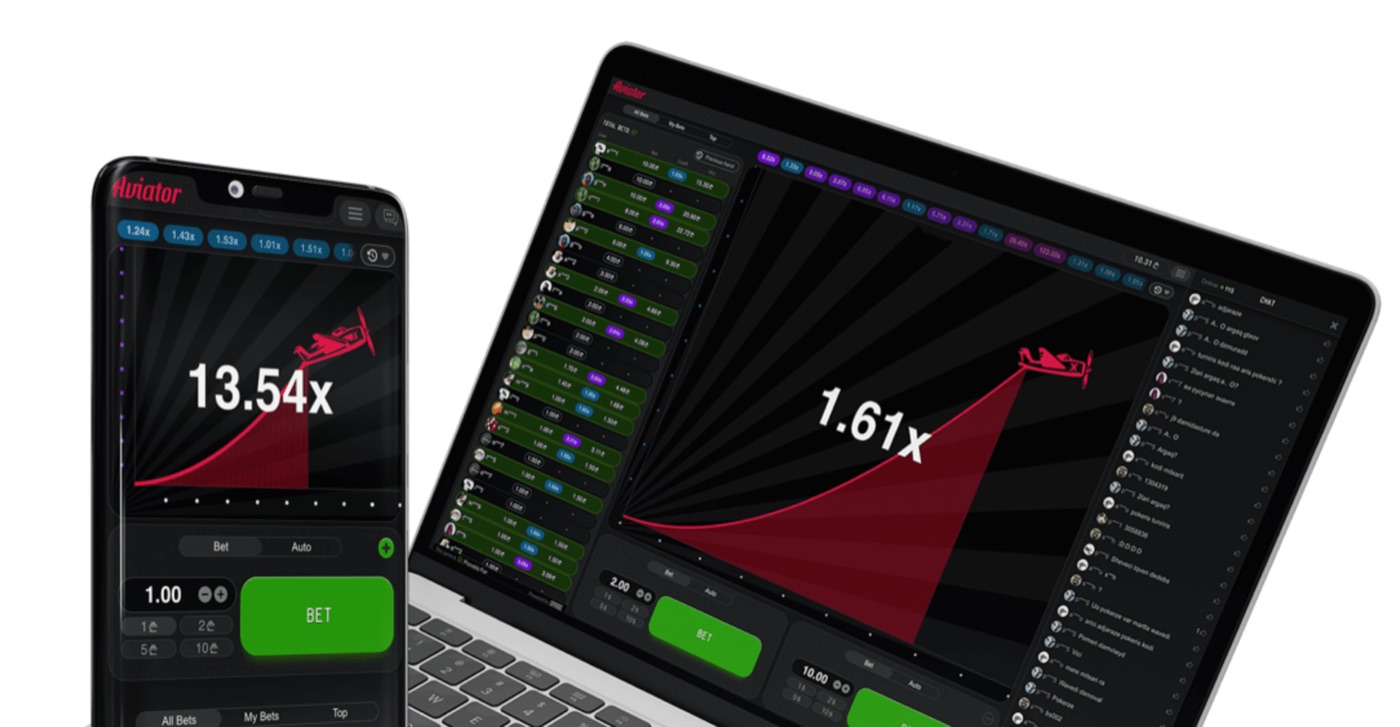
Aviator displays different multiplier points on a phone and a laptop.
Probability Table Explained
The Aviator probability table lists nine target multipliers from 1.2x to 100x. The listed chance falls from 80.8% at 1.2x to 0.97% at 100x.
The table shows a mathematical trade-off. A lower target appears more often, while a higher target appears less often. Neither target removes the 3% house edge.
| Target | Probability the round reaches it | Example return on a $10 stake |
|---|---|---|
| 1.2x | 80.8% | $12 |
| 1.5x | 64.7% | $15 |
| 2x | 48.5% | $20 |
| 3x | 32.3% | $30 |
| 5x | 19.4% | $50 |
| 10x | 9.7% | $100 |
| 20x | 4.85% | $200 |
| 50x | 1.94% | $500 |
| 100x | 0.97% | $1,000 |
The return column includes the original stake. A 2x cash-out on $10 produces $20 in total, which is a $10 profit before any later stake decision. A 1.5x cash-out produces $15, which is a $5 profit.
- Choose a target, such as 2x.
- Apply 0.97 divided by the target.
- Convert the decimal result into a percentage.
- Compare the result with the size of the possible return.
The expected value remains negative at every target. The expected value is -3% of the stake at every cash-out target. A change from 1.5x to 10x changes variance, not the edge.
Targets And Bankroll Size
Aviator bankroll planning starts with the stake, not the multiplier. Guides commonly suggest risking no more than 2% of the bankroll per round.
A $100 bankroll gives a 2% stake of $2. A $500 bankroll gives a 2% stake of $10. The operator controls the available minimum and maximum stakes, so the usable amount depends on the operator.
- $50 bankroll: a 2% round stake is $1.
- $100 bankroll: a 2% round stake is $2.
- $250 bankroll: a 2% round stake is $5.
- $500 bankroll: a 2% round stake is $10.
- $1,000 bankroll: a 2% round stake is $20.
That rule limits the amount exposed in one round. It does not make a target profitable. A 2% stake can still lose when the round crashes before the chosen cash-out point.
Consider a $100 bankroll and a $2 stake. At 2x, the total return is $4 if the cash-out succeeds. The profit is $2. At 10x, the total return is $20. The profit is $18, but the formula gives that target a 9.7% chance of being reached.
Consider the same $100 bankroll with a $5 stake. The stake is 5% of the bankroll. Five consecutive losses would expose $25 before any winning round is considered. This is not a prediction of the next five rounds; it is a direct measure of the amount placed at risk.
Set a loss limit and a win limit before starting. Stop when either limit is reached. Responsible gambling means not using money needed for ordinary expenses.
For a direct operator search about a crash game, multiplier, cash-out or stake, some players may use aviator lottostar login. The link does not change the formula, the target odds, or the operator’s limits.
Low And High Targets
The 1.5x target has a listed probability of 64.7%. The 10x target has a listed probability of 9.7%.
These figures make the difference clear. A lower target needs fewer rounds to appear in general, while a higher target requires a longer wait on average. Neither statement guarantees the result of an individual round.
Lower target examples
A $10 stake at 1.5x produces a $15 total return when the cash-out reaches the target. The profit is $5. The formula gives this target a 64.7% probability.
A $10 stake at 2x produces a $20 total return. The profit is $10. The formula gives this target a 48.5% probability. A player choosing 2x accepts a lower listed hit rate than a player choosing 1.5x.
- Use 1.2x when the chosen target is close to the starting point.
- Use 1.5x when the target sits below 2x.
- Use 2x when the target and return are balanced around the midpoint of the listed table.
Higher target examples
A $10 stake at 5x produces a $50 total return. The profit is $40. The formula gives this target a 19.4% probability.
A $10 stake at 50x produces a $500 total return. The profit is $490. The formula gives this target a 1.94% probability. This is a high-variance choice, not a dependable way to recover a loss.
- Use 3x for a 32.3% listed probability.
- Use 5x for a 19.4% listed probability.
- Use 10x for a 9.7% listed probability.
- Use 20x for a 4.85% listed probability.
- Use 50x or 100x only with a clear understanding of the lower listed probabilities.
Guides describe 5x to 50x as realistic long targets. That description does not make those targets likely in a particular round. It only places them within the range discussed for longer target choices.
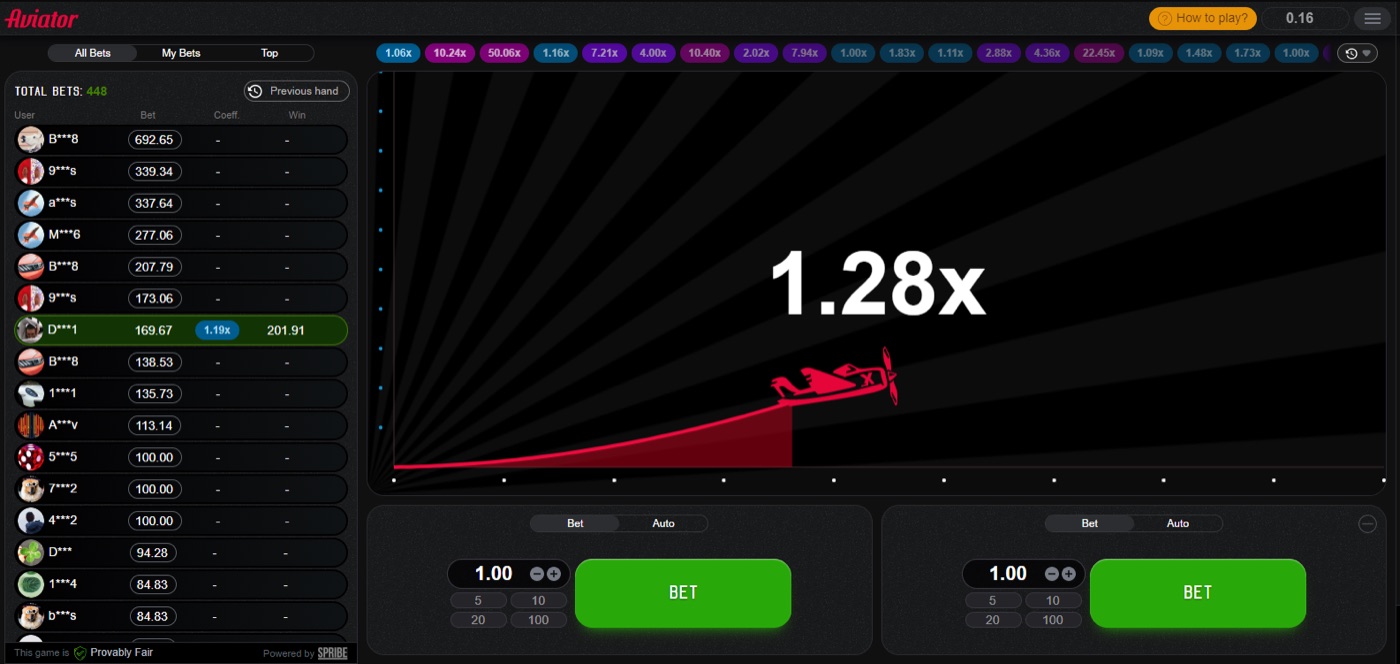
The Aviator plane moves upward while the multiplier increases.
Two Bets And Auto Cash-Out
Aviator provides two bet panels in each round. Each panel has a separate cash-out, so two stakes can use different target multipliers.
The Bet and Auto tabs control how a stake is placed. Auto Cash-Out uses a preset multiplier, while Auto Bet and Auto Play can cover 10 to 100 rounds with stop-on-win and stop-on-loss settings.
A split example uses a $10 total round budget. One $5 bet targets 1.5x, and the other $5 bet targets 5x. If the multiplier reaches 1.5x but stops before 5x, the first bet can return $7.50 while the second bet loses $5.
If the multiplier reaches 5x, both targets can be reached. The first $5 bet returns $7.50, and the second $5 bet returns $25. The total return is $32.50 on a $10 combined stake, before considering later rounds.
This structure changes the distribution of outcomes. It does not change the 3% house edge on either bet. The same 0.97/m formula applies to each target.
- Set the total round budget before dividing the stake.
- Assign the lower target to the first bet panel.
- Assign the higher target to the second bet panel.
- Check the possible return for each panel separately.
- Keep stop-on-loss settings aligned with the bankroll limit.
Auto features do not improve the odds. They reduce manual timing and apply preset instructions. A cash-out request must reach the server before the crash, so latency or a slow device can cause a time-out.
Fairness And Target Limits
Spribe publishes a SHA-256 hash of the server seed before each round. The crash point is fixed before take-off, and player client seeds are combined with the server seed.
After the round, the inputs can be checked with the verification tool inside the game. Neither the operator nor Spribe can change a result after the round starts.
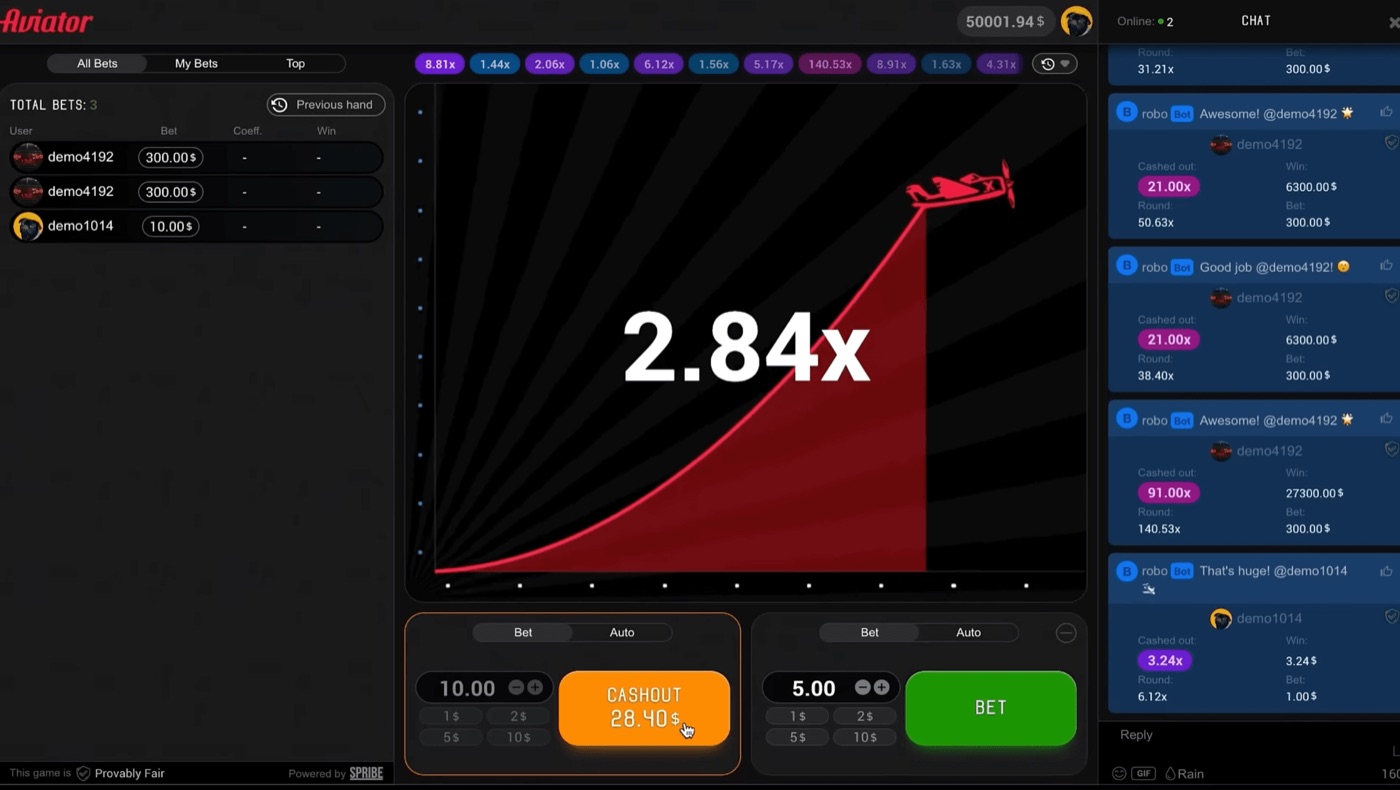
The Aviator interface shows live bets, chat and a cash-out at 28.40.
The fairness system supports checking the result. It does not reveal the next crash point. Prediction apps, signal bots, graph analysis, pattern claims and strategy chart PDFs do not change the 0.97/m probabilities.
- A hash commits the server seed before the round.
- Client seeds are combined with the server seed.
- The crash point is set before take-off.
- The verification tool checks the revealed inputs after the round.
- A cash-out must arrive before the crash.
Spribe does not publish a maximum multiplier. Guides quote different figures. Win caps per round are set by each operator, and available stakes also depend on the operator.
Aviator runs inside an operator website or app. Spribe does not provide a standalone official Aviator app. Demo mode exists and needs no registration, which allows target calculations without placing a real stake.
Aviator FAQ
Aviator uses a 97% RTP and a 3% house edge. Its target probability follows the formula 0.97/m.
The game offers two bet panels with separate cash-outs. The operator sets the available limits, while Spribe sets the game mathematics described by the formula.
What is the chance of reaching 2x?
The probability that an Aviator round reaches 2x is 48.5%. The calculation is 0.97 divided by 2. A particular round can still crash before 2x.
What is the chance of reaching 10x?
The probability that a round reaches 10x is 9.7%. A $10 stake cashed out at 10x produces a $100 total return when the target is reached.
How should a target match a bankroll?
Guides commonly suggest risking no more than 2% of the bankroll per round. A $100 bankroll therefore gives a $2 example stake, but the available stake range depends on the operator.
Does a higher target improve the edge?
No. The expected value is -3% of the stake at every cash-out target. Higher targets increase variance but do not remove the house edge.
Can an app predict the Aviator crash point?
No prediction app can determine the next crash point from the public information described here. The crash point is fixed before take-off, and rounds are independent.
Why can a cash-out time out?
A cash-out request must reach the server before the crash. Latency or a slow device can prevent the request from arriving in time.